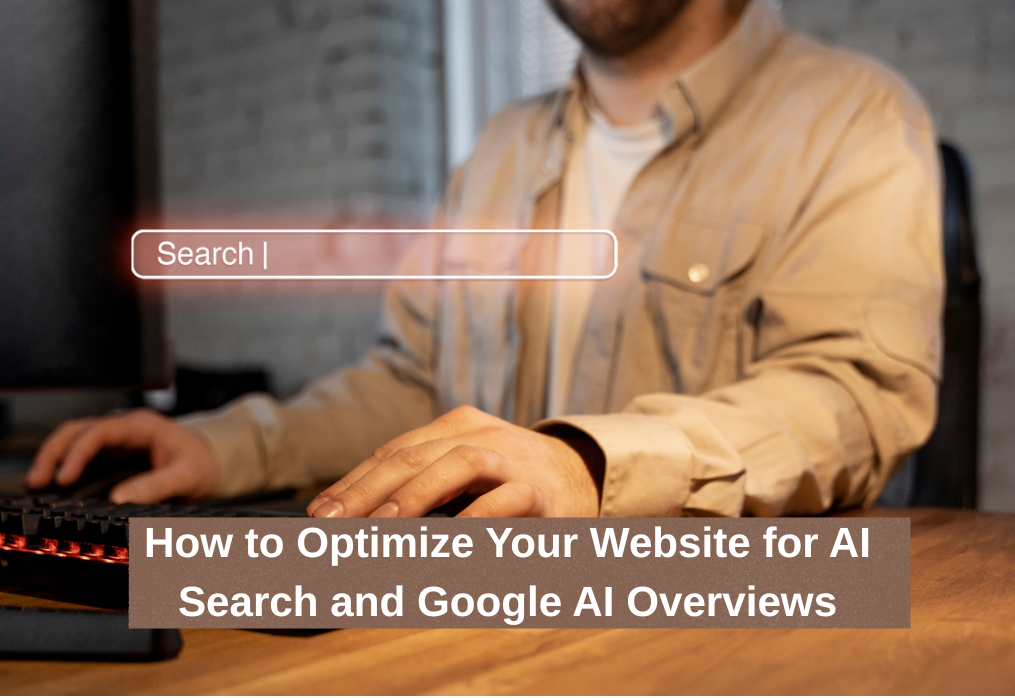

How to Optimize Your Website for AI Search and Google AI Overviews
Search is changing faster than ever.
A few years ago, ranking on the first page of Google was the primary goal for most businesses. Today, users are increasingly getting answers directly from search engines through AI-generated summaries, conversational responses, and Google AI Overviews. Instead of clicking multiple links, people often find what they need without leaving the search results page.
This shift is changing how businesses approach SEO. It’s no longer just about ranking pages, it’s about becoming a trusted source of information that AI systems can understand, reference, and recommend.
That’s where AI search optimization comes into the picture. Businesses that adapt early will have a better chance of maintaining visibility as search continues to evolve.
What Is AI Search and Why Is It Transforming SEO?
AI search uses artificial intelligence to understand user intent and deliver direct, contextual answers instead of simply displaying a list of websites.
Google AI Overviews, AI-powered assistants, and conversational search tools are all designed to provide faster and more relevant information. Rather than relying solely on keywords, these systems analyze topics, context, credibility, and user intent.
For businesses, this means that traditional ranking factors still matter, but they are no longer enough on their own. Content must be structured in a way that helps search engines understand and extract useful information.
This is why many marketers are now focusing on AI search optimization alongside traditional SEO strategies.
Why Website Optimization for AI Is Important for Business Growth
As AI-driven search experiences become more common, businesses need to rethink how they create and organize content.
The goal is no longer just appearing in search results. The goal is becoming the source that AI platforms trust when generating answers.
Effective website optimization for AI can help businesses:
- Improve visibility in AI-generated search results
- Increase brand authority and trust
- Attract highly relevant traffic
- Improve user experience
- Stay competitive as search technology evolves
Think about how people search today. Instead of typing short keywords, they ask complete questions like:
“What is the best way to improve local SEO?”
“How do I optimize my website for AI search?”
AI systems are designed to answer these questions directly. Businesses that create content around real user questions are more likely to be referenced in those responses.
How to Optimize Your Website for AI Search and Google AI Overviews
There is no single trick that guarantees visibility in AI-generated search results. However, several proven practices can significantly improve your chances.
1. Create Content That Answers Questions Clearly
AI systems prioritize content that provides direct, useful answers.
Instead of writing lengthy introductions before addressing the topic, focus on answering user questions early and clearly. Think about the questions your customers ask most often and build content around those topics.
2. Focus on EEAT Signals
Google continues to emphasize Experience, Expertise, Authoritativeness, and Trustworthiness.
Showcase real expertise through case studies, industry insights, author profiles, and practical examples. Businesses that demonstrate credibility are more likely to be trusted by both users and search engines.
3. Structure Content for Easy Understanding
Well-organized content is easier for AI systems to process.
Use:
- Clear headings and subheadings
- Bullet points where appropriate
- Short paragraphs
- Logical content flow
When information is easy to understand, it becomes easier for AI platforms to extract and present.
4. Optimize for Conversational Search Queries
People increasingly search using natural language.
Instead of focusing only on short keywords, create content that answers complete questions and conversational search phrases. This approach helps align content with how users interact with AI-powered search tools.
5. Use Structured Data and Schema Markup
Schema markup helps search engines understand the purpose and context of your content.
While users may never see it, structured data can improve how search engines interpret information and increase the likelihood of appearing in enhanced search features.
6. Keep Content Updated
AI systems tend to favor accurate and relevant information.
Regularly updating blogs, service pages, and resources helps maintain credibility and ensures your content remains useful over time.
Businesses looking to optimize website for AI search should view content as an ongoing process rather than a one-time task.
AEO vs Traditional SEO: Understanding the Shift in Search
For years, SEO focused on helping webpages rank higher in search results.
Today, many businesses are also investing in AEO or Answer Engine Optimization.
While traditional SEO aims to improve rankings, AEO focuses on helping content become the answer itself.
Traditional SEO
- Focuses on website rankings
- Targets keywords and organic traffic
- Encourages users to click through to webpages
- Prioritizes search engine visibility
AEO
- Focuses on direct answers
- Targets user intent and questions
- Helps content appear in AI-generated responses
- Supports visibility within conversational search experiences
Businesses that embrace both SEO and Optimized Answer Engine strategies are often better positioned for future search trends.
Rather than choosing one over the other, the most effective approach is combining both methods to maximize visibility.
Common AI Search Optimization Mistakes Businesses Should Avoid
As search engines become smarter and AI-powered results continue to evolve, many businesses are unknowingly making SEO mistakes that hurt their visibility. From ignoring user intent to publishing low-value content, these issues can impact both traditional rankings and performance in AI-driven search experiences.
– Writing Only for Keywords
Keyword optimization still matters, but content should be written for people first. Over-optimizing content often reduces readability and user engagement.
– Ignoring User Intent
Not every search has the same purpose. Understanding why users are searching is just as important as understanding what they are searching for.
– Publishing Thin Content
Short, low-value content rarely performs well in AI-driven environments. Content should provide genuine insights and practical value.
– Neglecting Website Experience
A slow website, confusing navigation, or poor mobile experience can negatively impact performance regardless of content quality.
– Treating AI Search as a Separate Strategy
AI search is not replacing SEO, It is evolving. Businesses should integrate AI-focused practices into their existing SEO efforts rather than viewing them as completely separate initiatives.
Stay Ahead of AI Search with Bigg Jump
The way people search is changing, and businesses that adapt early will have a significant advantage.
At Bigg Jump, we help businesses prepare for the future of search by combining proven SEO services with modern AI-focused strategies. Our approach focuses on creating content that performs well for both traditional search engines and emerging AI-powered search experiences.
As a trusted digital marketing agency in Mumbai, we understand that visibility today requires more than keyword rankings. It requires authority, relevance, and a content strategy designed around how people actually search.
Whether you’re looking for professional digital marketing services, or searching for reliable branding and marketing services in Marol Mumbai, our team helps businesses build sustainable digital growth strategies that are ready for the future.
At Bigg Jump, we believe the businesses that succeed tomorrow are the ones preparing for change today.